|
| "East Meets Tokyo" |
 |
 |
|
|
| |
01 |
|
|
|
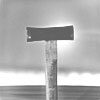
This hammer
has been used for more than 70 years. It is Master Maeda's precious belonging.
One side of its metal part has a gentle curve, so it does not wound woods.
And the handle is made of Gum-tree, so it does not wound the carpenter's
hand either.
|
|
|
|
|
|
| |
02 |
|
|
|
Sukiya carpenters
mainly depend on their eyes, skills, and experience. Without all the deliberate
care, it is impossible that the tearoom would be sustainable for hundreds
of years.
|
|
|
|
|
|
| |
03 |
|
|
|
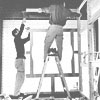
Sukiya carpenters
always work with partnership. One holds a pillar and the other unites a
joint by hitting the wood. So, one is not enough and three is too many;
they always work with two.
|
|
|
|
|
|
| |
04 |
|
|
|
Master Shizuka
Maeda, 59, from Kyoto. He is one of the top Sukiya craftsmen.
|
|
|
|
|
|
| |
05 |
|
|
|
Master Maeda
spent over three hours for sharpening the blades of his planer. Touch, feel,
and caress. Sharpen, rinse, and touch. Again, again, and again.
|
|
|
|
|
|
| |
06 |
|
|
|
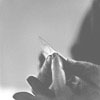
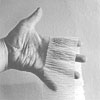
With Maeda’s
careful sharpening, the surface shaved from the wood reaches less than a
micron in thickness. Maeda applies this technique as its finish on each
wood. The strip is thin like a tissue paper, but still strong as a silk
scarf.
|
|
|
|
|
|
| |
07 |
|
|
|
One of the
most distinguished characteristics of Sukiya is that there are no nails,
but just joints of woods.
|
|
|
|
|
|
| |
08 |
|
|
|
Carpenters and
designers are discussing the progress in front of their "blue print."
For sukiya-carpenters, the computerized blue print is not that important.
Rather, they depend on their own eyes, skills, and experience.
|
|
|
|
|
|
| |
09 |
|
|
|
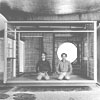
Mr. Maeda (left)
and Mr. Yoshikoshi (right) stand in front of the on-going construction site
right before they close the day.
|
|
|
|
|
|
| |
10 |
|
|
|
They relocate
from Kyoto to Tokyo for a month during the project. They commute from their
business-hotel to the site by subway everyday.
|
|
|
|
|
|
| |
11 |
|
|
|
This project
is unconventional. The tearoom is located in a modern office building just
in front of the Imperial Palace in Tokyo. The tearoom is built as the symbol
of a company's $6million-renovation-project.
|
|
|
|
|
|
| |
12 |
|
|
|
"Normally
tearooms are located outside, so we never have such a space-trouble,” Maeda
explains while he is carefully examining the alignment by the office window
|
|
|
|
|
|
| |
13 |
|
|
|
Architect Kiyoshi
Kuronuma, who is in charge of the entire renovation project, checks up the
details of the tearoom. With his arrival, tension takes over everyone in
the location.
|
|
|
|
|
|
| |
14 |
|
|
|
After taking
off its final dress (Maeda shaved micro-thin surface of woods, c.f. picture07),
the wood sparks fragrance. People enjoy its fresh scent and smooth touch.
|
|
|
|
|
|
| |
15 |
|
|
|
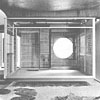
This is the
completion of the carpenters’ work. Essence of Japanese traditional tearoom
is expressing eternity in its minimal space.
|
|
|
|
|
|
| |
16 |
|
|
|
The very last
moment of the two master-carpenters at the location. Since Sukiya does not
use any nail, people can take apart the pieces and rebuild the tearoom anytime
even after a couple hundred years.
|
|
|
|
|
|
| |
17 |
|
|
|
After spending
one month in Tokyo, two master-craftsmen return to their hometown, Kyoto.
|
|
|
|
|
|
| |
18 |
|
|
|
A month later,
the tearoom shows its final figure. A flower vase, wall papers, and calligraphy
by the window make even accents. Architect Kuronuma palms the steppingstones
with "purity" water for appreciation.
|
|
|
|
|
|
|
|